
Knowing Yourself Well in the Age of AI
A BUDDHIST PERSPECTIVE
Part 1 (of 2): The Difference Between Intelligence and Consciousness
Do you ever feel that it’s a little strange that AI is getting to know us better and better?
Historically speaking, no one really knew your inner world better than you did. Maybe, when you were younger, your parents knew you better. But the fact that a somewhat vague computer system—which almost no one understands exactly how it works anymore—sometimes seems to know you better than you know yourself… and can even push exactly the right buttons to make you do what the system wants you to do: that’s new.
With the arrival of AI in our lives, something significant has changed.
By now, many of us regularly work alongside AI. I, for one, have found it to be a great brainstorming partner. It helps me organize ideas, translate texts, and improve technical aspects of the website. Sometimes it feels like I have a very capable office manager who makes my life easier in certain areas.
And at the same time, there’s the other side: AI and algorithms have also become part of an economy that runs on attention. Your attention. The longer you keep watching, the more money is made. And to achieve that, it turns out to be very effective not to press our “calm” and “content” buttons, but rather the buttons that “turn us on”: fear, anger, outrage, and uncertainty.
From a Buddhist perspective, this topic is interesting because it brings us right back to the core of the practice: know yourself. Know your mind. Know your tendencies. Know which seeds lie within you—and which ones you’re watering.
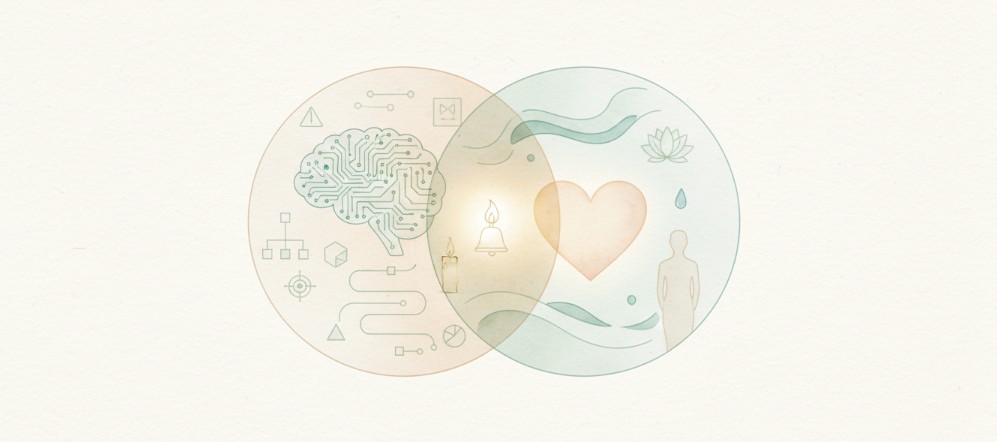
Intelligence is not the same as consciousness
To stay mindful in this age of AI, it helps to make a distinction that I personally find incredibly enlightening: the difference between intelligence and consciousness.
Yuval Noah Harari—a brilliant historian who speaks frequently about AI and has also been meditating in the Vipassana tradition for years—boiled this down to something very simple in an interview with two Buddhist monks (link to the interview at the bottom of this article):
- Every sentient being has the capacity to suffer.
- Intelligence is the capacity to make decisions based on information in order to achieve a goal.
AI is now impressively intelligent in many areas. It can recognize patterns that we miss. It can make connections at lightning speed. It can write texts that sometimes feel almost eerily good; it’s a good translator.
But it lacks consciousness. It has no body that builds up tension. No heart that breaks. No nervous system that recoils in fear. It cannot suffer. It cannot wake up in the middle of the night with a knot in its stomach. Nor can it truly love.
That doesn’t mean AI is “harmless”—on the contrary. Precisely because it is so intelligent, it can be used very effectively to achieve goals. And the goals of large companies that use AI and algorithms to achieve a specific objective with you aren’t necessarily about your mental health or your inner freedom. The goal is often simple: engagement. To hold your attention for as long as possible.
AI and Buddhism
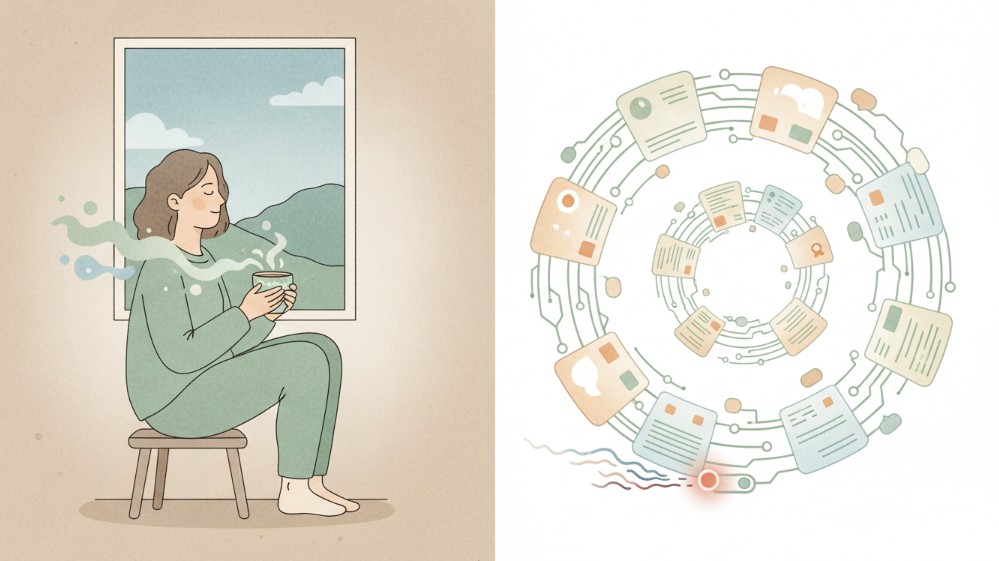
AI has now also made its way into Buddhism. We can find countless Buddhist interviews and talks on YouTube. There are apps, meditation platforms, transcripts, and summaries created with the help of AI.
For example, AI can be a great tool for making information—such as books, teachings, and talks—more accessible or for extracting summaries on specific topics.
When you feed large archives into an AI system, you can ask, for example: “What would Thich Nhat Hanh say about injustice? How can you practice with that in mind?” And then AI can formulate an answer in warm language, based on what Thich Nhat Hanh actually said on that topic.
That can be helpful—as long as we remain clear in these conversations with AI: it is not a living teacher. It is not a sentient being. It is a mirror of data. And it can only be as wise as the sources you feed into it.
For Buddhist practitioners, this is immediately a wonderful exercise in right understanding: neither romanticizing nor demonizing. Just looking clearly: what is this, and what is it not?

Money needs to be made (and AI is used for that)
Another reality is that there are large companies behind AI and social media that are eager to make a lot of money. AI is used for that purpose. With lightning-fast intelligence, AI has figured out how to keep people on a platform for as long as possible.
Social media has essentially been boiled down to one word: engagement. It’s all about keeping people interested so they keep scrolling—so that more ads can be inserted and the companies can make their money.
And then AI and the platforms discovered something we’ve actually known for a long time, but which is now being applied on a massive scale: people stick around much longer when a negative trigger is activated.
When you listen to a nice song on Instagram or watch a cute cat video, you might want to see a few more. It gives you a brief, pleasant feeling. But when the news reports that record-high temperatures have been reached, that climate change will make things much worse, that danger is looming—that’s when the “fear” button gets pressed. And you hold onto that button. You start reading more. Searching more. Checking more. You want certainty. You want control. And that’s exactly what’s worth its weight in gold for a platform.
AI then sends you all kinds of messages that confirm your fears over and over again. You end up in a downward spiral. You’re trapped in a flood of information, and the algorithm has you in its grip.
A Few More Thoughts on Algorithms
What is an algorithm? (a simple explanation)
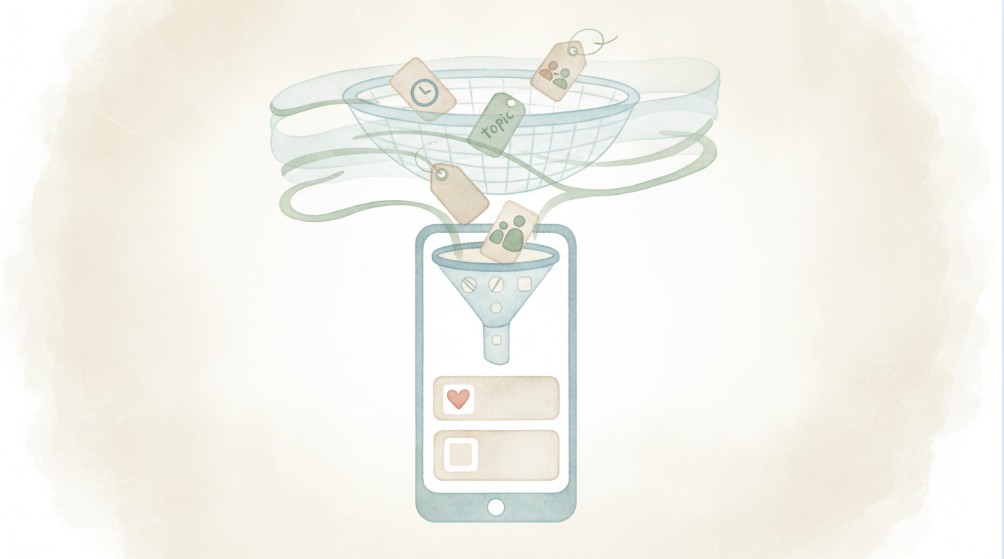
This might be old hat, but let’s keep it practical: an algorithm is a set of rules that determines what you see.
On Instagram, Google, YouTube, and other platforms, the algorithm uses signals such as:
- what you click on
- how long you watch
- what you save or share
- what you search for
- which accounts you follow
What’s remarkable is that today, everyone gets a personalized page the moment they do anything online. Two people can search for the same topic and get completely different suggestions. Not because the topic is different, but because the algorithm knows you based on your history and uses that to make assumptions about what you’d most like to see.
I like to compare it to a supermarket with thousands of products. There’s a little bit of everything. But you might buy fifty products on a regular basis. When you swipe your loyalty card at the register, it keeps track of exactly what you buy, how often, and in what combination. That’s how it works online, too. It tracks what you do, search for, and view. And the algorithm builds your personal “online supermarket.” As soon as you step through the door of the World Wide Web, the web adapts to your behavior.
Do you like action movies? Then you’ll get news about actors, trailers, suggestions for new movies—and ads for popcorn and soda.
Are you concerned about injustice in the world? Then you’ll get more injustice. Are you concerned about climate change? Then you’ll get more climate change. And if your system notices that you keep lingering on posts that evoke fear, then you’ll get… more fear.
How can we apply the practice of mindfulness when working with AI? Practical tips for practice. What intensifies polarization in society, positive search behavior, and a list of feel-good YouTube channels. Continue in Part 2: Knowing Yourself Well in the AI Era—A Buddhist Perspective.
Below is an interview with Yuval Harari by two monks from Clear Mountain Monastery about AI, the Information Diet, and the teachings of the Buddha.